
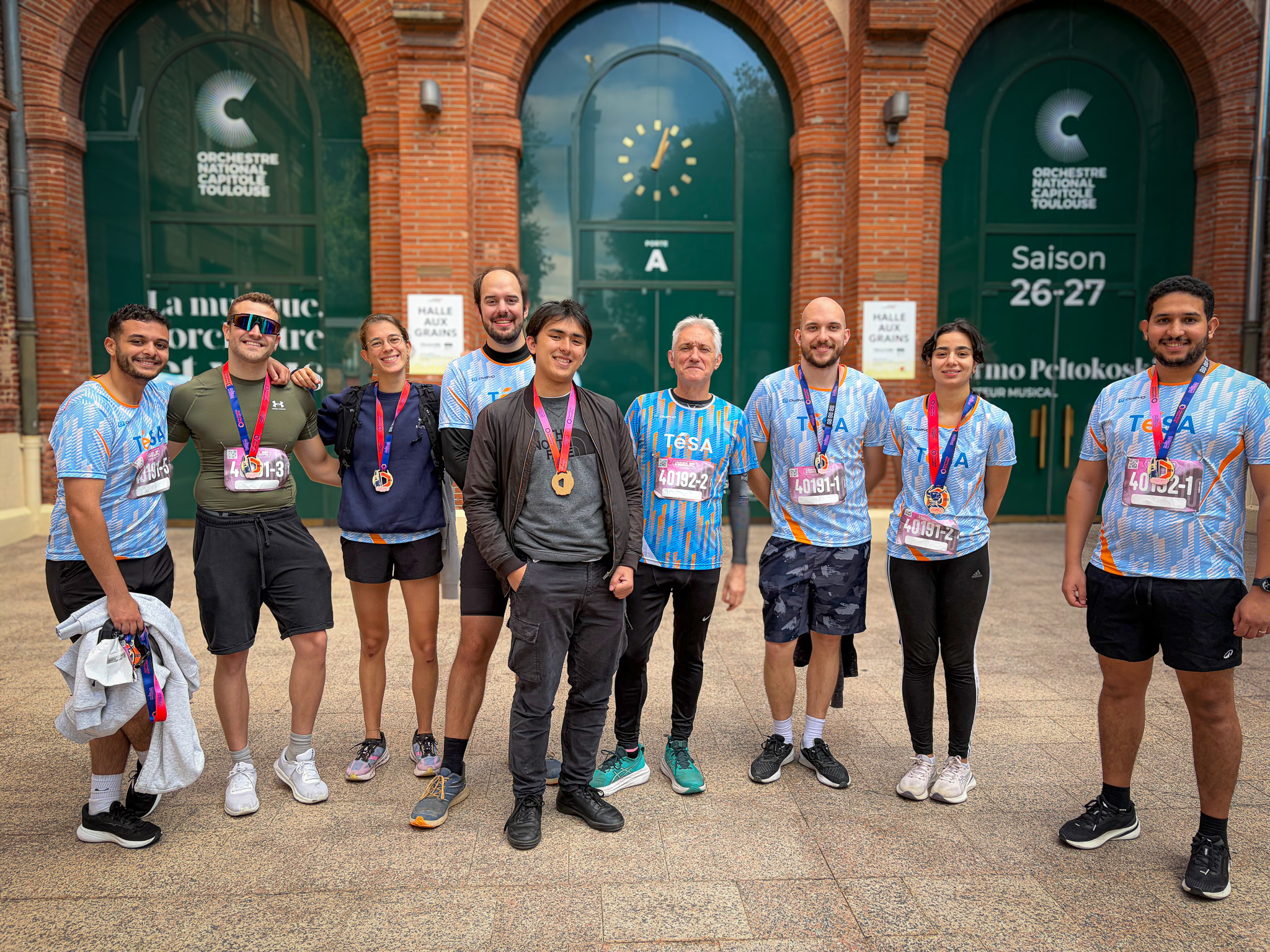
TéSA Shines at the Toulouse Métropole Run Experience
42.195 kilometers is a long distance. Together, each kilometer is shared. 🏃
On November 1st, for the third consecutive year, the colors of TéSA were present at the Toulouse Métropole Run Experience.
🤝 In Team TéSA A, the relay was passed from Ayoub Hamza to @Jean-Yves Tourneret, then to @Clement Lacire and @Marie Le Dantec.
🤝 In Team TéSA B, it circulated from @Alexandre Berezin to @Karima GHAMNIA, then to @Samuele Alteri, Robin Duprat and @Younes Boutiyarzist[.
Each member chose the number of kilometers to cover.
📍 Some sections were longer than others, but all counted to reach the finish line of the “Relais des Pionniers de l’Aéropostale”. 🏁
In the half-marathon, @Lorenzo Ortega and @Nicolas Gresset-Bourgeois carried our colors.
Well done to everyone for this beautiful collective commitment, reflecting the cooperation that drives our laboratory.
Are you interested in our research work 🔬?
Find us at https://www.tesa.prd.fr 🛰️, we would be delighted to exchange with you!
#TeSA
#Doctorat
#Recherche
#TraitementDuSignal
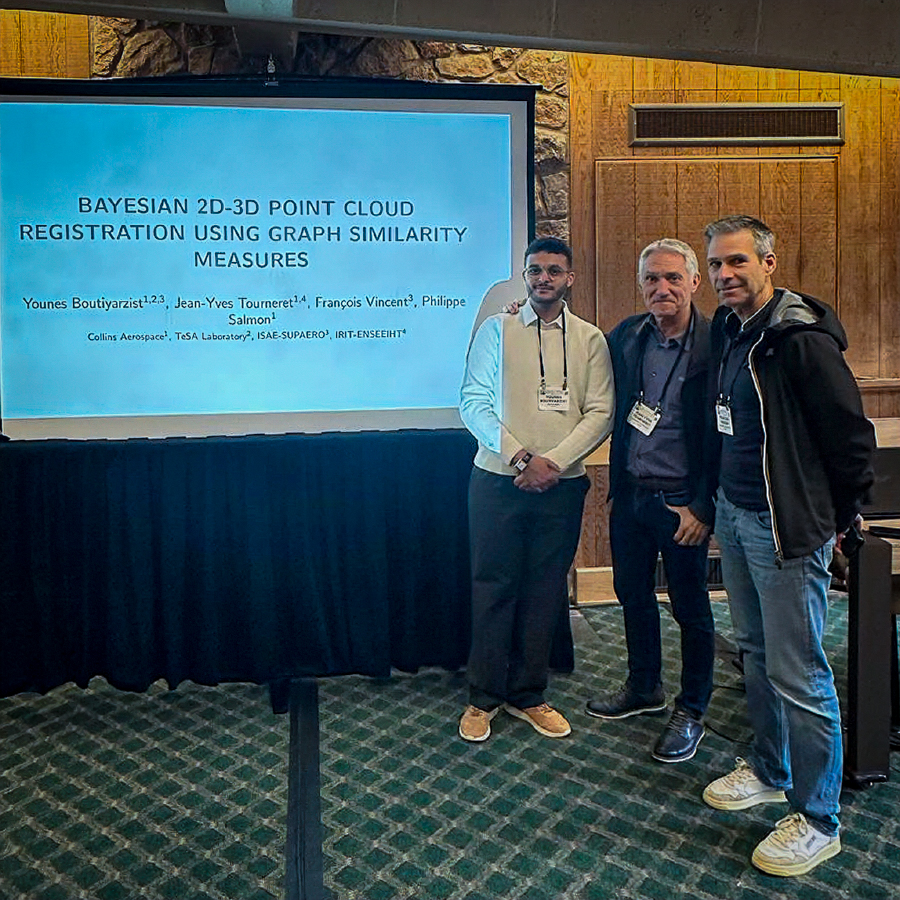
Younes Boutiyarzist presents his work at Asilomar
🎓 Toulouse → Pacific Grove: @Younes Boutiyarzist represented TéSA in California!
On October 26, our PhD student presented an invited paper at the Asilomar conference on signal processing. He spoke in the session dedicated to learning and Bayesian inference on graphs.
🚁 His topic: autonomous helicopter landing.
Younes combines two sensors: a camera, which produces 2D images, and a LiDAR, a laser sensor that produces 3D point clouds.
📡 Making different sensors cooperate is an elegant and efficient solution. However, their data must “speak the same language”: they must first be aligned with precision.
🔬 Younes’s method relies on graph theory to compare the structure of 3D points with that of image pixels. A Bayesian estimation then performs this registration.
🤝 This work illustrates the cooperation between academic research and industry. The thesis is co-supervised by @Jean-Yves Tourneret (Toulouse INP-ENSEEIHT), @francois vincent (ISAE-SUPAERO, Institut Supérieur de l’Aéronautique et de l’Espace) and @Philippe Salmon (Collins Aerospace, partner member of the laboratory).
Are you interested in our research work 🔬?
Find us at https://www.tesa.prd.fr 🛰️, we would be delighted to exchange with you!
#TeSA
#Doctorat
#Recherche
#TraitementDuSignal
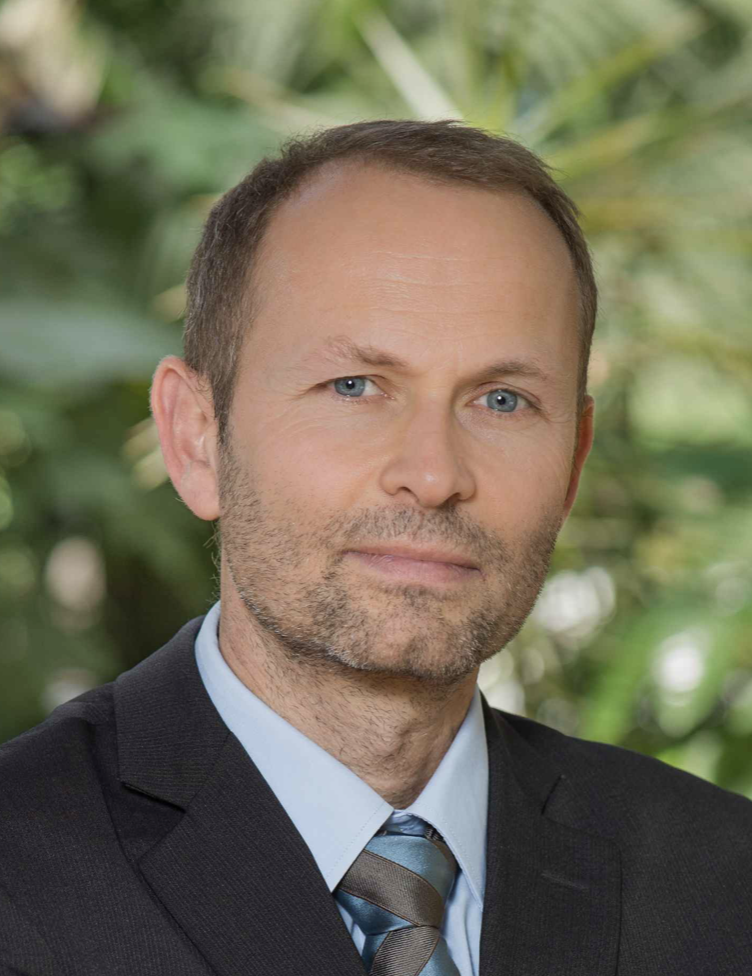
Didier Le Boulc’h joins the TéSA Association Board
Who oversees the smooth running of a cooperative laboratory? 🛰️
At TéSA, the Association Board meets every two months. It reviews the research laboratory’s activities.
📅 On October 16, it welcomed a new representative from Thales Alenia Space, a partner member of TéSA. @didier Leboulch becomes Secretary of the Board, alongside President @Thierry Floriant and Treasurer @Elias BITAR, and succeeds @Xavier O., whom we warmly thank for all his involvement.
🎓 A SUPAERO engineer (now ISAE-SUPAERO, Institut Supérieur de l’Aéronautique et de l’Espace) who graduated in 1989, Didier Le Boulc’h first spent ten years at the DGA (Direction générale de l’armement). There, he worked on electronic warfare, stealth, and military communications. He then coordinated space telecommunications programs at the CNES (Centre national d’études spatiales).
📡 With Thales Alenia Space since 2005, he led telecom systems engineering, R&D, then product policy and Telecom strategy. He is today Vice President of Telecom Solutions Strategy and a Thales Fellow. His contributions include:
satellite electrification and payload digitization (the equipment that ensures the satellite’s mission)shift toward 5G and software-defined satellite Space Inspirebroadband constellations and direct connection between satellite and phone (Direct to Device)new generation of military telecommunications satellites (milsatcom)
🏆 He is the author of about ten patents and the 2019 winner of the Ingénieur Manager trophy from L’Usine Nouvelle.
Expertise in space telecommunications in service of TéSA’s governance. Welcome, Didier!
Are you interested in our research work 🔬?
Find us at https://www.tesa.prd.fr 🛰️, we would be delighted to exchange with you!
#TeSA
#Doctorat
#Recherche
#TraitementDuSignal
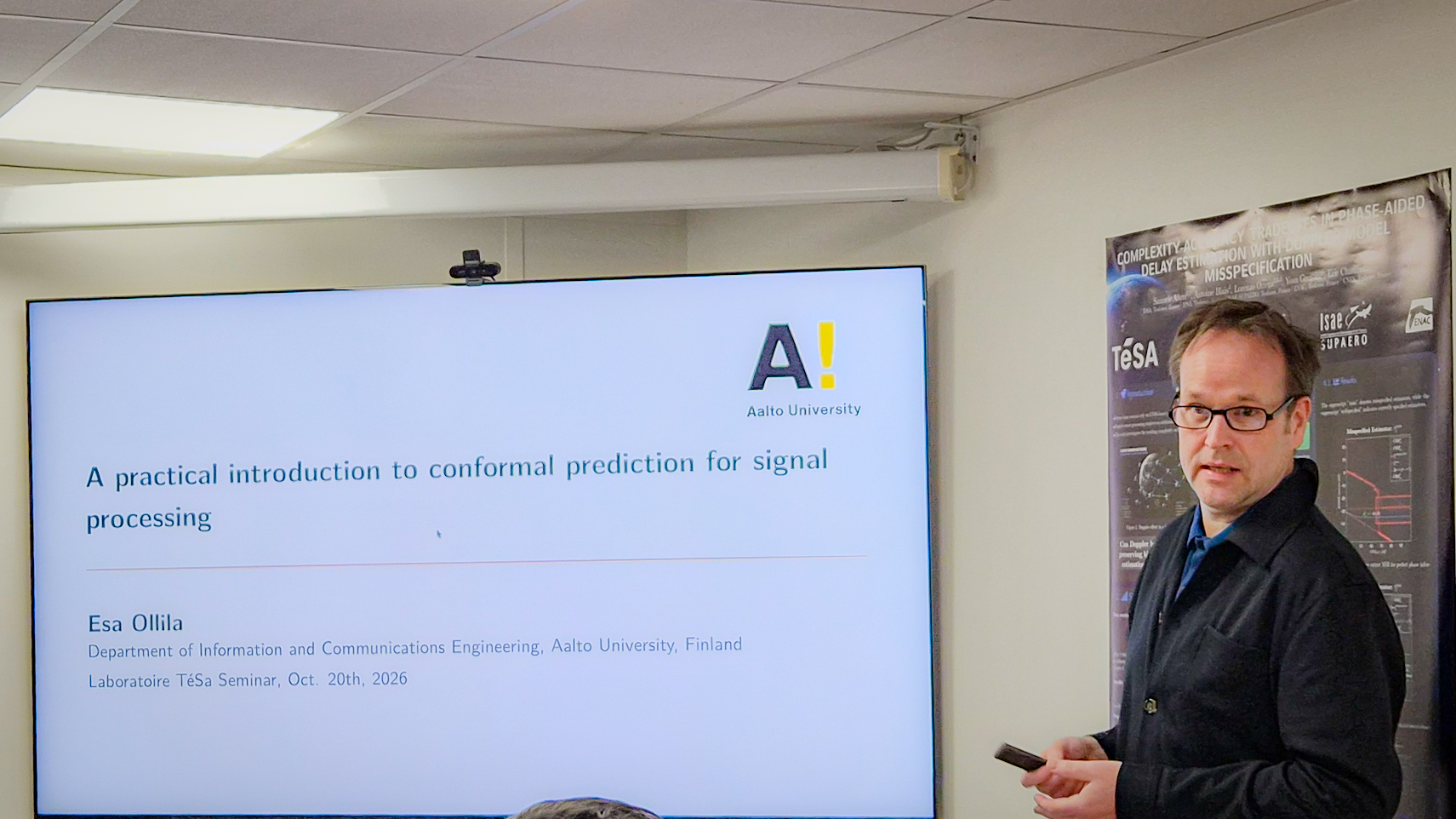
Esa Ollila presents conformal prediction
Can we trust the prediction of a neural network? 🤔
This was the question addressed by [Esa Ollila], a professor at Aalto University (Finland), during his seminar at TéSA this Tuesday, October 20. The laboratory has been pleased to host him for several weeks 🎓
Holder of a PhD in statistics and signal processing, he is the deputy head of the Department of Information and Communications Engineering at Aalto University. He also sits on the board of directors of EURASIP (European Association for Signal Processing).
His answer: conformal prediction 📐, a method that:
• adapts to any artificial intelligence model without modifying it
• associates a set of possible outcomes with each prediction, with a reliability guarantee
• remains valid even with a limited volume of data
For systems where every decision matters, such as space 🛰️ or aerospace ✈️, having a reliable measure of uncertainty is a major asset.
A specialist in robust statistics, @Esa Ollila is a co-author of the book “Robust Statistics for Signal Processing” (Cambridge University Press, 2018) 📘. His presentation, illustrated by a Python notebook 💻, concluded with applications in signal processing.
Thank you for this contribution!
Are you interested in our research work 🔬?
Find us at https://www.tesa.prd.fr 🛰️, we would be delighted to exchange with you!
#TeSA
#Doctorat
#Recherche
#TraitementDuSignal
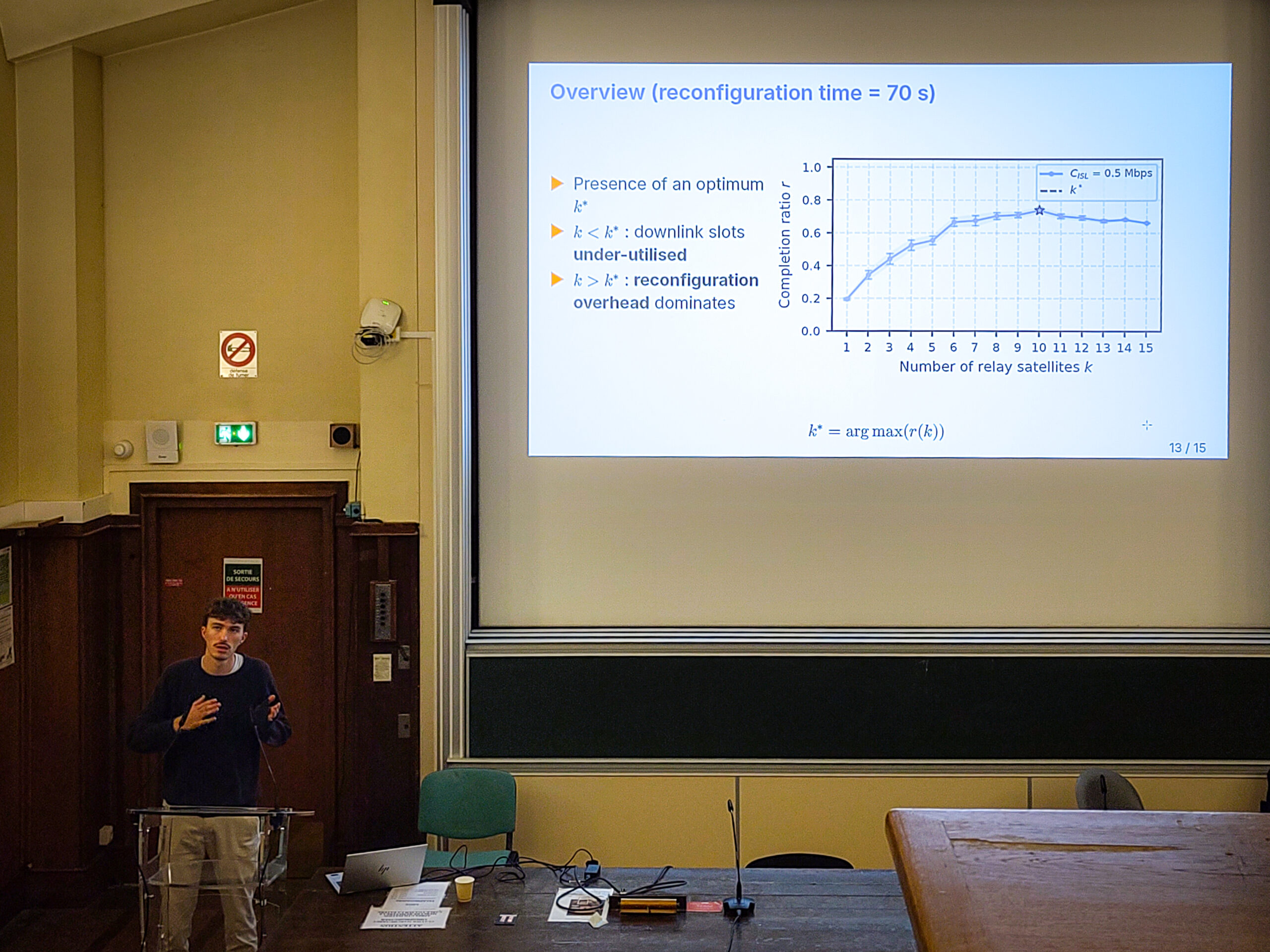
Nicolas Gresset-Bourgeois optimizes nanosatellite relays
📡 How many relay satellites are required for a nanosatellite constellation to efficiently transmit its data to Earth?
This was the question addressed on October 14 by @Nicolas Gresset-Bourgeois, a PhD student at TéSA, during the NTN Days in Paris.
🛰️ The NTN Days (Non-Terrestrial Networks) are the annual gathering of the French-speaking satellite network community. For this 4th edition, hosted at @Cnam Paris (Conservatoire national des arts et métiers), laboratories and industry representatives exchanged over two days.
Titled “On the Optimal Number of Relays for Nanosatellite Downlink,” his presentation detailed the analysis of the number of relays required in a low Earth orbit (LEO) nanosatellite constellation.
🎓 His thesis is supervised by @Riadh Dhaou (ENSEEIHT) and @Emmanuel Lochin (ENAC, École Nationale de l’Aviation Civile). It is co-funded by the CNES (Centre National d’Études Spatiales) and Viveris, with Bernard Pontet and @David Pradas actively following the progress of the work.
🔭 This work extends TéSA’s commitment, with CNES support, to nanosatellite constellations. For several years, the laboratory has contributed to this field, particularly regarding clock synchronization, precise positioning, and fair network sharing.
Are you interested in our research work 🔬?
Find us at https://www.tesa.prd.fr 🛰️, we would be delighted to exchange with you!
#TeSA
#Doctorat
#Recherche
#TraitementDuSignal
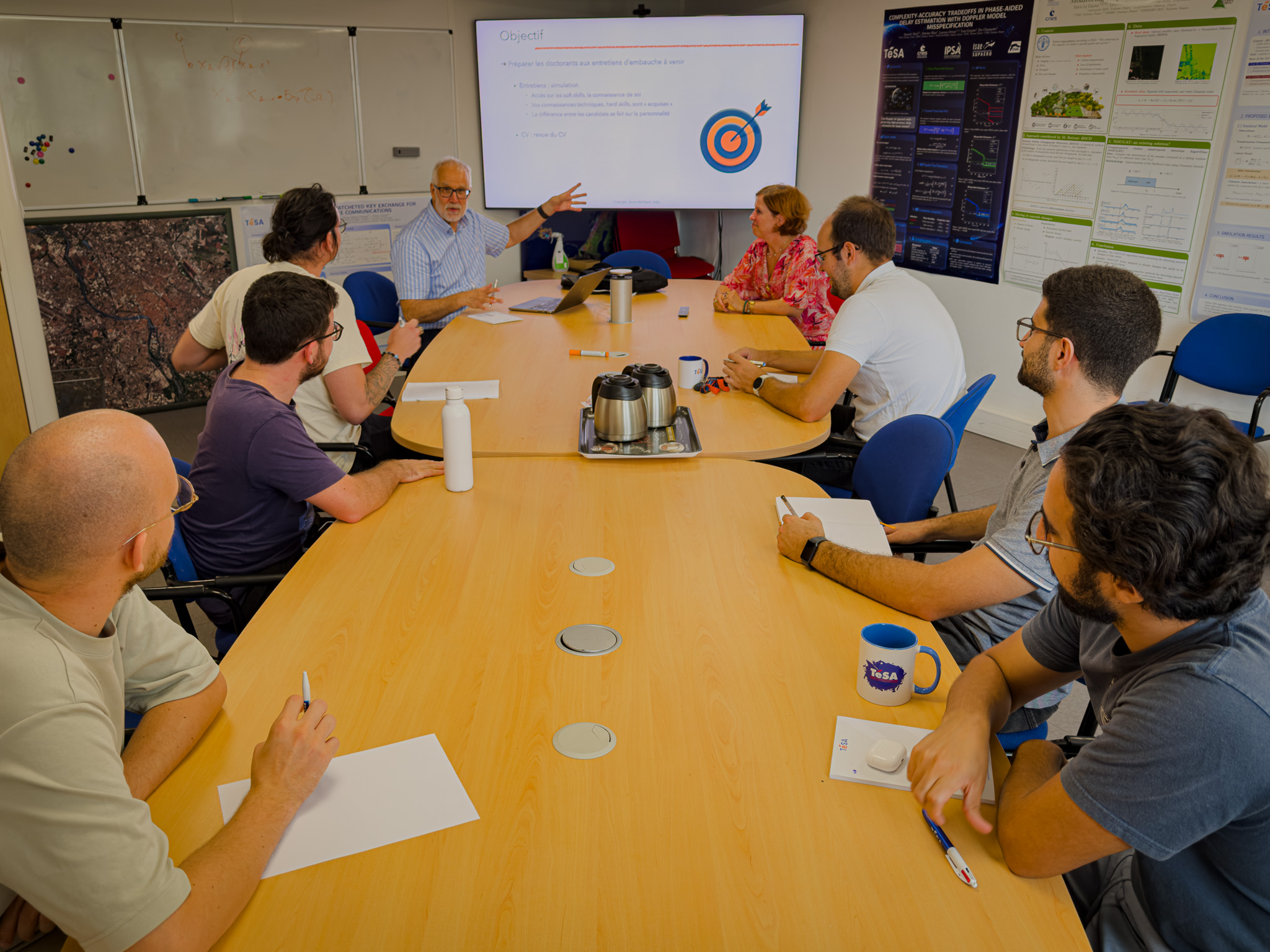
TéSA launches employment support for its PhD students
🎓 Kickoff for a new cohort! The launch meeting opened the support program for third-year PhD students heading toward their first job.
Upon completing a PhD, technical expertise is solid. In interviews, what often makes the difference is self-awareness and the ability to speak about oneself.
In 35 years of career in the aerospace and defense industry, @Xavier Barichard has recruited more than 200 engineers. He has seen brilliant profiles miss out on a position for failing to present themselves well. He puts this experience at the service of our PhD students.
The program, spread over four months, unfolds in three stages:
🔍 individual workshops to step back and reflect on one’s career path and better know oneself;
🗣️ group workshops to build one’s “pitch” and LinkedIn profile;
🎯 a mock interview before peers, with a review of the CV.
This cohort brings together six PhD students who are in the final stretch before their defense:
👉 @yassine ariouich, @Alexandre Berezin, @Alexandre Brochard, Robin Duprat, @Julien Juaneda, @Youssef Minyari.
Their expertise is solid. Now it is time to master the art of showcasing it! 🚀
Are you interested in our research work 🔬?
Find us on TéSA, we will be delighted to exchange with you!
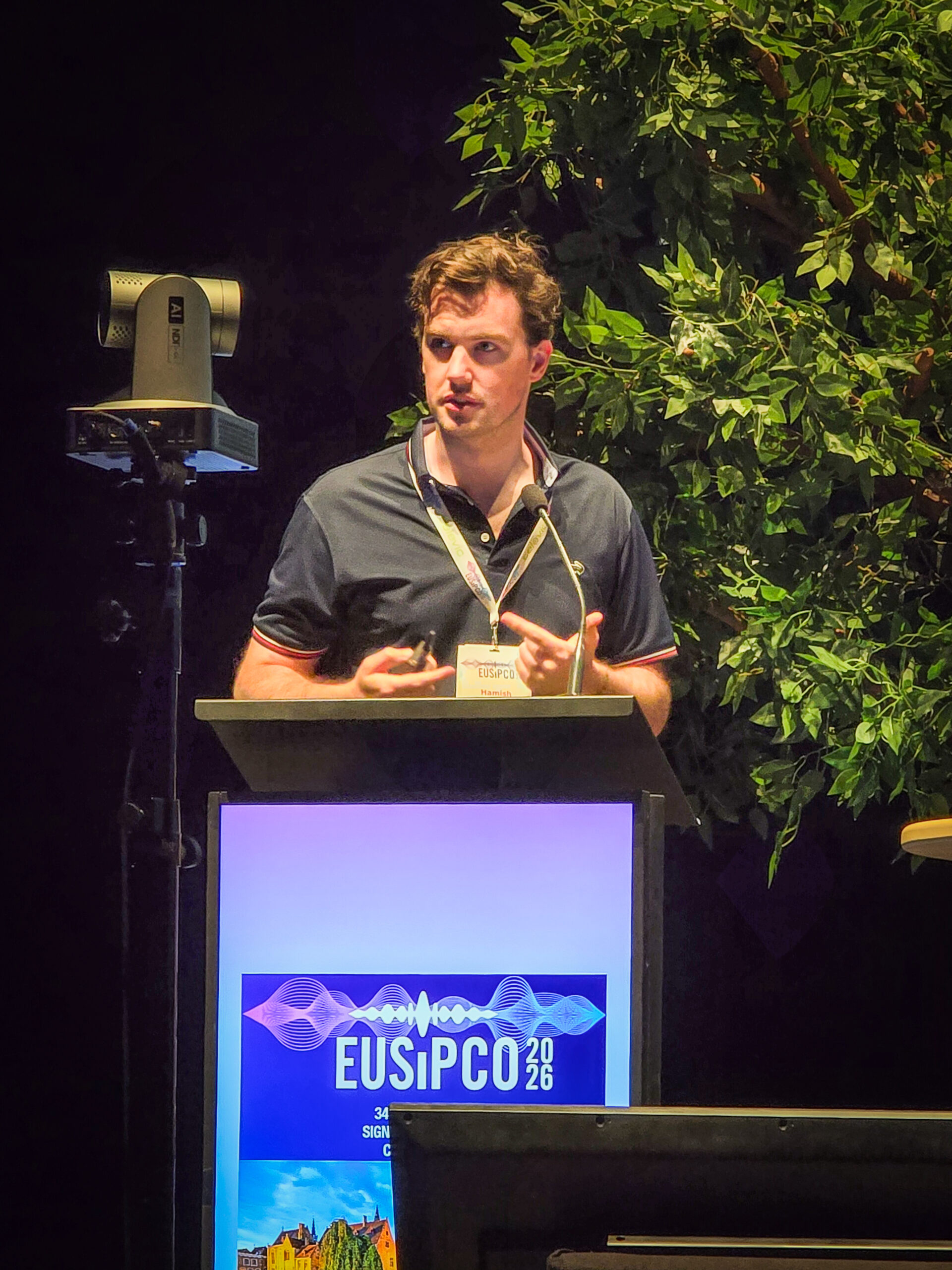
Detecting Satellite Clock Drifts by Hamish McPhee
🛰️ Automatically detect satellite clock drifts before they affect measurements.
@Hamish McPhee, a teaching researcher at the Institut Polytechnique des Sciences Avancées (IPSA) and a TéSA affiliated researcher, presented a new change detection method at the European Signal Processing Conference (EUSIPCO) 2026: “Changepoint Detection Using the Complete Likelihood Ratio Test: Application to Satellite Clock Anomalies” 📡.
The behavior of onboard clocks ⏰ can evolve under the influence of environmental factors, with a direct impact on the reliability of satellite measurements. The proposed method, based on a likelihood ratio robust to outliers, enables a more systematic detection of these changes — a key issue for the reliability of space systems 🚀.
This work, conducted with @Jean-Yves Tourneret (ENSEEIHT) and co-funded by Thales Alenia Space, illustrates TéSA’s ability to address the operational issues of its industrial partners. It also continues the support from CNES, which has been accompanying TéSA for several years on nanosatellite swarms through PhDs and R&D studies.
Did you know that a clock offset of one microsecond corresponds to a position error of 300 km 😱 ?
A little nod from the session: even experts in clock anomalies ⏰ can be surprised by time 🤭 ! @Hamish McPhee sped up his presentation at the end, thinking he only had one minute left, when he actually had six. Those minutes were greatly put to use for rich exchanges with the audience.
Are you interested in our research work 🔬 ?
Find us at https://www.tesa.prd.fr 🛰️, we would be delighted to exchange with you !
#TeSA
#Research
#SignalProcessing
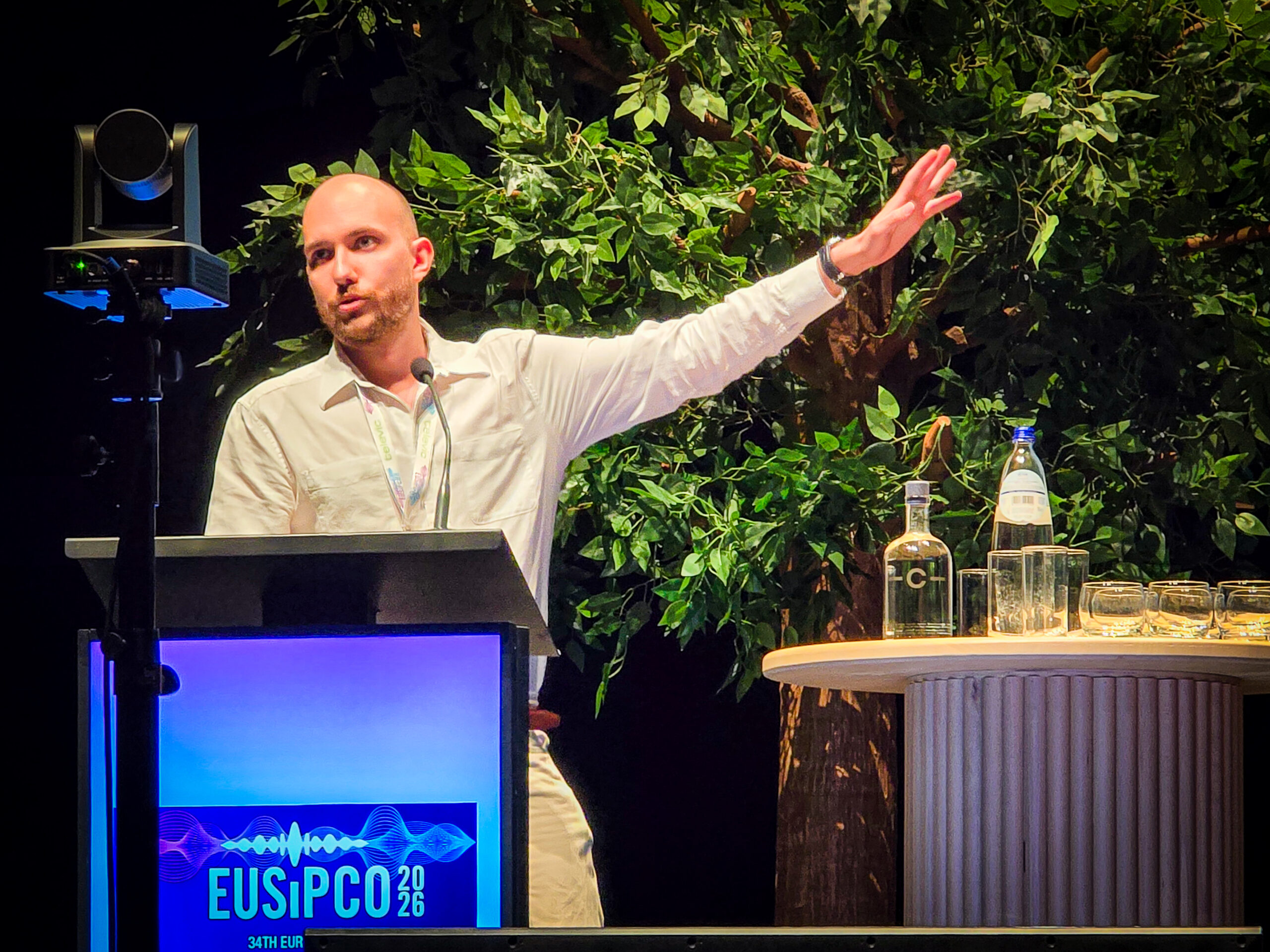
Alexandre Berezin analyzes turbine blade vibrations in turbofans
✈️ How to analyze turbofan blade vibrations directly during actual engine tests?
@Alexandre Berezin, a TéSA PhD student working on a CIFRE thesis at Safran Aircraft Engines, presented his paper “A Bayesian Model for Order-Based Modal Analysis” 🎤 at the European Signal Processing Conference (EUSIPCO) 2026.
His study focuses on the modal analysis of turbofan blades, based on signals from strain gauges placed on these same blades during tests on a complete engine 🛠️. His method allows for the identification of the evolution of vibration modes during the test and their association with theoretical modes obtained through numerical calculation.
This work is supervised academically by @Jean-Yves Tourneret (ENSEEIHT) and François Vincent (ISAE-SUPAERO), and industrially by Yann Rotrou (Safran Aircraft Engines).
A concrete example of collaboration between academic research and the industrial world, in service of the reliability of aircraft engines 🛩️.
Are you interested in our research work 🔬 ?
Find us at https://www.tesa.prd.fr 🛰️, we would be delighted to exchange with you!
#TeSA
#PhD
#Research
#SignalProcessing
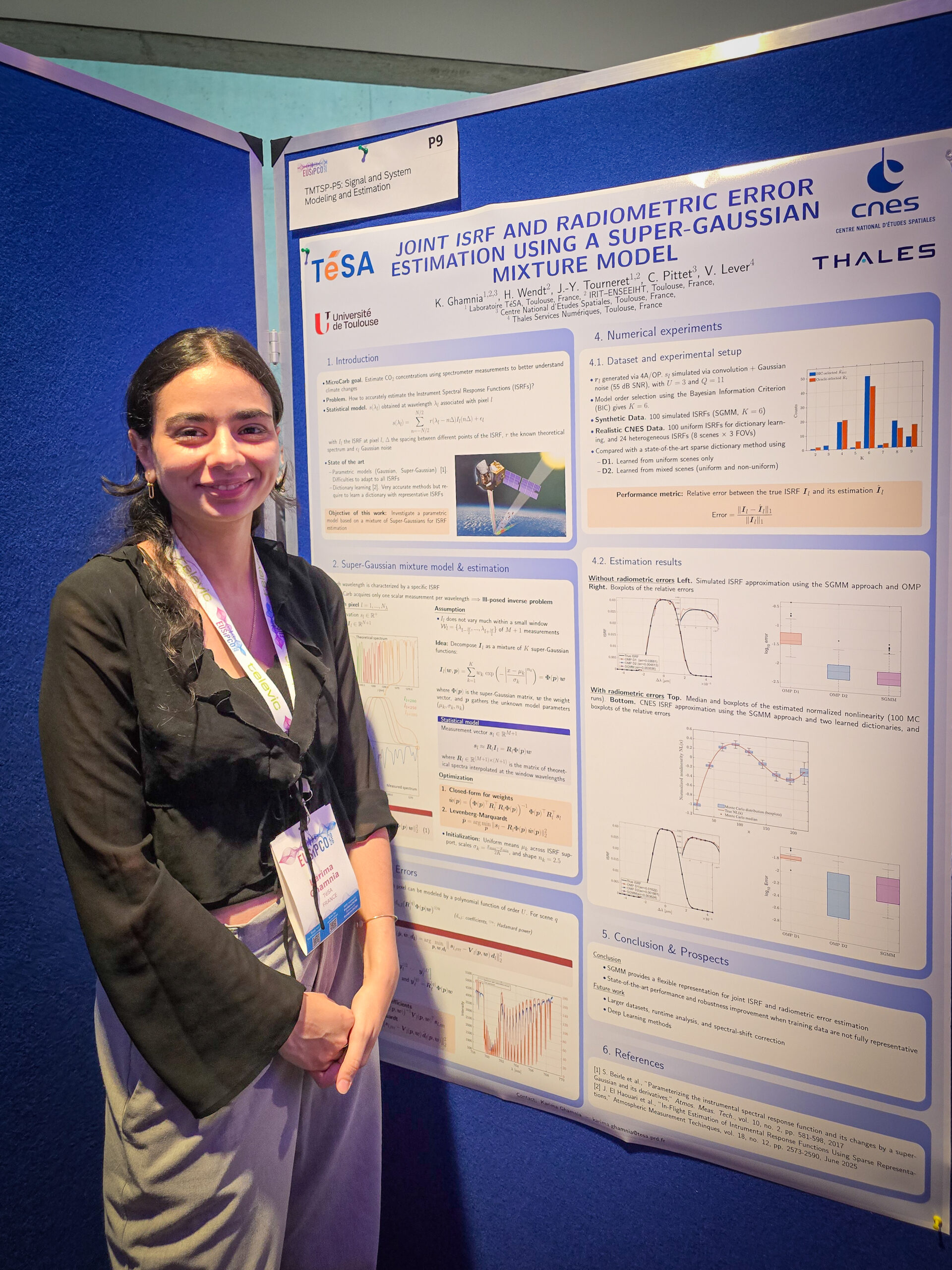
Karima Ghamnia optimizes satellite-based CO2 measurement
📡 “A very fine spectral line is never perfectly measured: the instrument always distorts it slightly.”
This is the phenomenon studied by @Karima GHAMNIA, a TéSA PhD student, in the paper she presented at the European Signal Processing Conference (EUSIPCO) 2026: “Joint ISRF and Radiometric Error Estimation using a Super-Gaussian Mixture Model”.
Her application domain is the MicroCarb satellite (CNES) 🛰️, which measures atmospheric CO2 concentration by analyzing sunlight ☀️ reflected by the Earth 🌍. For these measurements to be reliable, it is essential to accurately characterize how the spectrometer distorts the signal—its instrumental spectral response function (ISRF)—as well as the measurement errors that accompany it.
Her method allows estimating both simultaneously, without requiring a large reference dataset, unlike existing approaches 📊.
Her work is supervised by @Herwig Wendt (CNRS), her PhD advisor, @Jean-Yves Tourneret (ENSEEIHT), @Christelle Pittet (CNES), and Vincent Lever (Thales Services Numériques) 🎓.
Are you interested in our research work 🔬?
Find us at https://www.tesa.prd.fr 🛰️, we would be delighted to exchange with you!
#TeSA
#PhD
#Research
#SignalProcessing
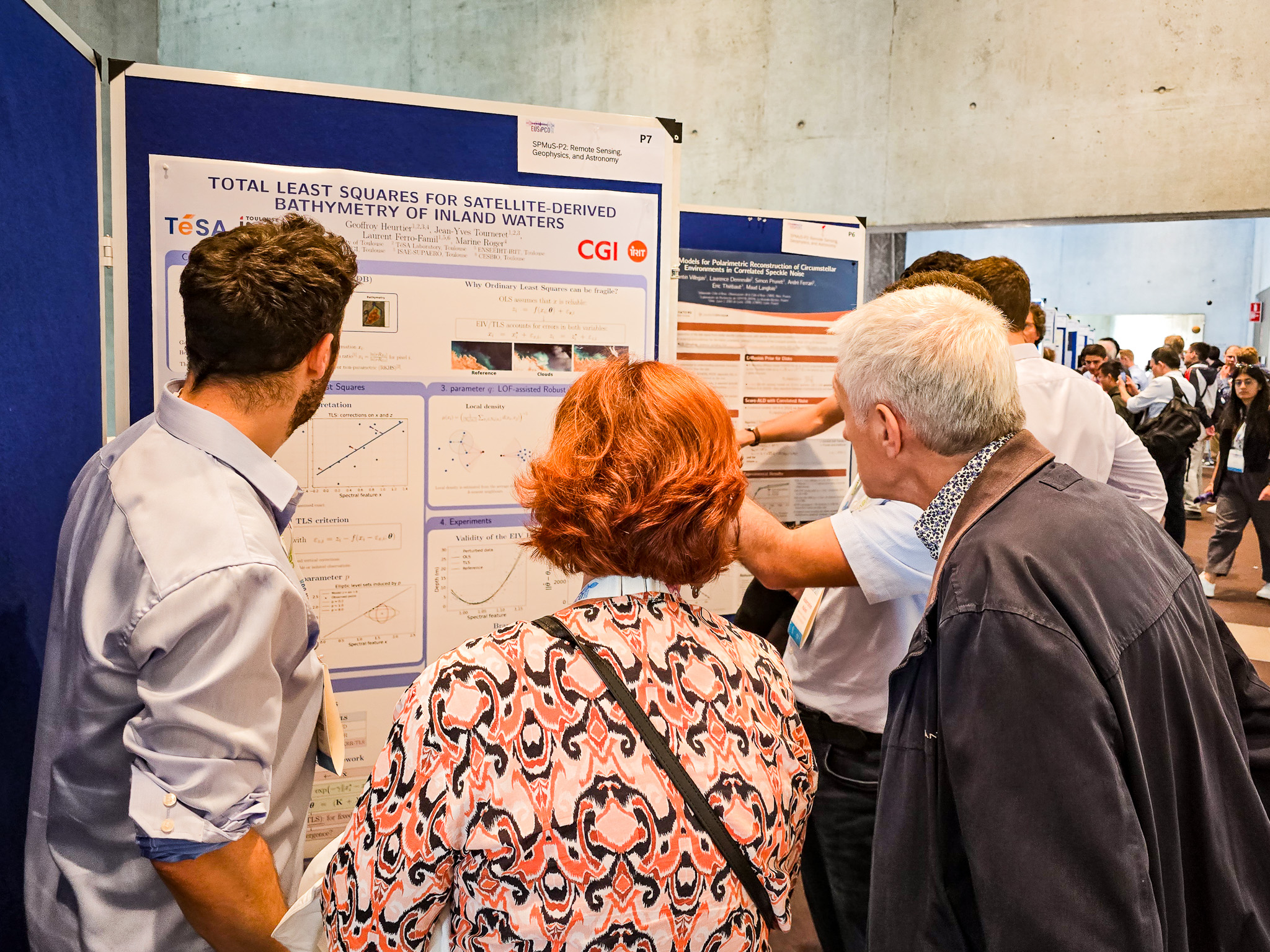
Satellite bathymetry: an innovative statistical method
📡 How to measure the depth of a lake… from space?
This is the challenge tackled by @geoffroy heurtier, a TéSA PhD student 🛰️, in his poster presented at the European Signal Processing Conference (EUSIPCO) 2026: “Total least squares for satellite-derived bathymetry of inland waters”.
Bathymetry — the topography of the water bottom — is usually measured using drones or boats equipped with sonar. However, this is a costly method, as it is difficult to deploy everywhere, requires one or more operators, and must be repeated regularly because the bottom evolves over time 🌊.
The idea, co-developed with @Jean-Yves Tourneret (ENSEEIHT), Laurent Ferro-Famil (ISAE-SUPAERO) and @Marine ROGER, PhD (CGI), is to use the color of the water 🎨 observed by satellite to estimate the depth. The darker the water, the deeper it is — but many other factors also influence this color. @geoffroy heurtier proposes a statistical method that accounts for the noise present in both the depth measurements and the satellite data, significantly improving accuracy, particularly for deep zones 📊.
Concrete application: monitoring available water volumes, a key issue during drought periods for arbitrating between agricultural, industrial, and domestic uses 💧.
Are you interested in our research work 🔬?
Find us at https://www.tesa.prd.fr 🛰️, we would be delighted to exchange with you!
#TeSA
#Doctorat
#Recherche
#TraitementDuSignal

ADDRESS
7 boulevard de la Gare
31500 Toulouse
France

CONTACT


