
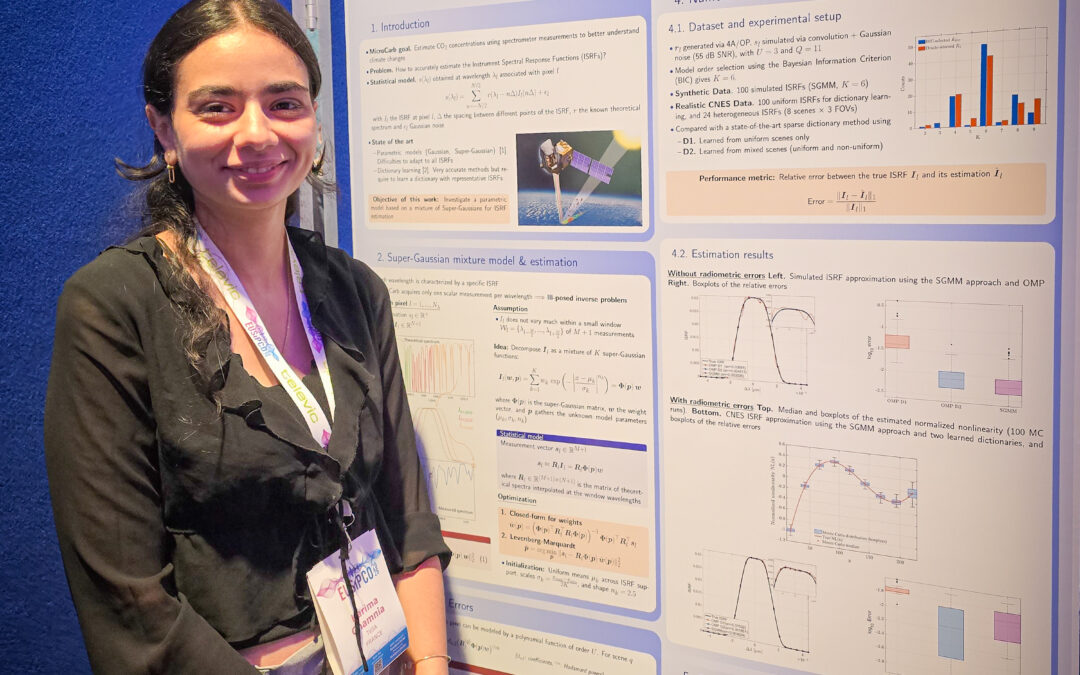
📡 “A very fine spectral line is never perfectly measured: the instrument always distorts it slightly.”
This is the phenomenon studied by @Karima GHAMNIA, a TéSA PhD student, in the paper she presented at the European Signal Processing Conference (EUSIPCO) 2026: “Joint ISRF and Radiometric Error Estimation using a Super-Gaussian Mixture Model”.
Her application domain is the MicroCarb satellite (CNES) 🛰️, which measures atmospheric CO2 concentration by analyzing sunlight ☀️ reflected by the Earth 🌍. For these measurements to be reliable, it is essential to accurately characterize how the spectrometer distorts the signal—its instrumental spectral response function (ISRF)—as well as the measurement errors that accompany it.
Her method allows estimating both simultaneously, without requiring a large reference dataset, unlike existing approaches 📊.
Her work is supervised by @Herwig Wendt (CNRS), her PhD advisor, @Jean-Yves Tourneret (ENSEEIHT), @Christelle Pittet (CNES), and Vincent Lever (Thales Services Numériques) 🎓.
Are you interested in our research work 🔬?
Find us at https://www.tesa.prd.fr 🛰️, we would be delighted to exchange with you!
#TeSA
#PhD
#Research
#SignalProcessing