
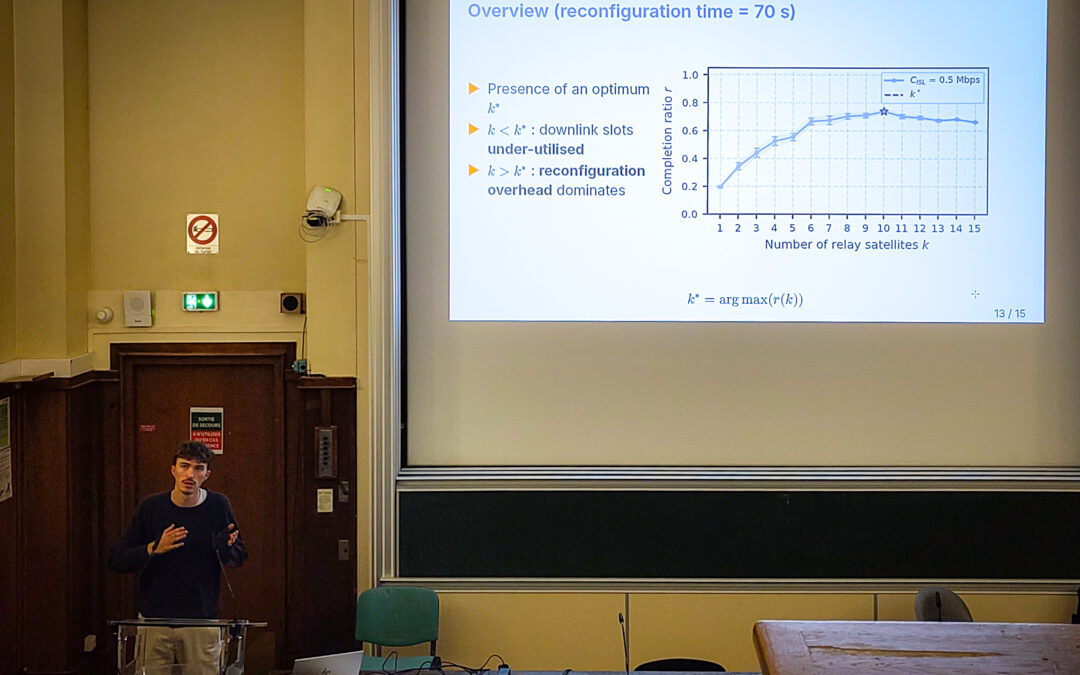
📡 How many relay satellites are required for a nanosatellite constellation to efficiently transmit its data to Earth?
This was the question addressed on October 14 by @Nicolas Gresset-Bourgeois, a PhD student at TéSA, during the NTN Days in Paris.
🛰️ The NTN Days (Non-Terrestrial Networks) are the annual gathering of the French-speaking satellite network community. For this 4th edition, hosted at @Cnam Paris (Conservatoire national des arts et métiers), laboratories and industry representatives exchanged over two days.
Titled “On the Optimal Number of Relays for Nanosatellite Downlink,” his presentation detailed the analysis of the number of relays required in a low Earth orbit (LEO) nanosatellite constellation.
🎓 His thesis is supervised by @Riadh Dhaou (ENSEEIHT) and @Emmanuel Lochin (ENAC, École Nationale de l’Aviation Civile). It is co-funded by the CNES (Centre National d’Études Spatiales) and Viveris, with Bernard Pontet and @David Pradas actively following the progress of the work.
🔭 This work extends TéSA’s commitment, with CNES support, to nanosatellite constellations. For several years, the laboratory has contributed to this field, particularly regarding clock synchronization, precise positioning, and fair network sharing.
Are you interested in our research work 🔬?
Find us at https://www.tesa.prd.fr 🛰️, we would be delighted to exchange with you!
#TeSA
#Doctorat
#Recherche
#TraitementDuSignal